
Feature
The rise of LLMs in robotic surgery
As large language models (LLMs) are increasingly applied in robotic surgery, good data and well-reasoned application will likely prove the decisive factors towards success, writes Ross Law.
Powered by



The combined rising value proposition of AI and robotic surgery present a huge potential market. Video credit: Freepik
Cover Story
Precision in paradise: the Dominican Republic emerges as Latin America’s medtech hub
The Dominican Republic is emerging as a strategic nearshoring hub for the US, driven by a rapidly expanding medical device manufacturing sector enjoying industrial free zones, tax incentives and international trade agreements. By Bernard Banga.

Agentic AI in medicine supports multitasking across clinical tools, data and workflows to improve decision-making and efficiency. Credit: Volodymyr Horbovyy / Shutterstock
With artificial intelligence (AI) becoming an omnipresent focus of innovation in the healthcare sector, it should come as no surprise that large language models’ (LLMs) application in robotic surgery is becoming an area of growing interest.
According to GlobalData analysis, AI in healthcare is forecast to reach a $19bn valuation by 2027. Paired with the overall global robotic surgical systems market, which is set to reach a valuation of $9.2bn by 2034, up from $2.9bn in 2024, as per a GlobalData market model, the intersection of the space’s present a large value proposition.
For robotic surgery, LLMs, a form of AI trained on datasets to perform a stated function, are having a strong impact on how robotic surgery is planned, executed, and taught. Specifically, LLMs hold potential in supporting surgeons in making complex interoperative decisions and in accelerating skill acquisition.
Research indicates that the technology not only presents opportunities for integration towards improving existing surgical robotic processes, but in companies’ robotic surgical system development pathways.
However, as LLMs’ use rises, a potential issue with their integration into medtech areas such as robotics, is the heterogeneity of use cases, says Erez Kamanski, CEO of AI compliance company Ketryx.
“In order to prove that something works, you need to prove it for a specific thing that it does. And so companies [using LLMs in robotic surgery] would need to create a lot of different use cases for the products, and then run evaluations and tests that prove, for a wide percentage of those designated situations, that it does work.”
Kaminski also highlights that medical device regulations require a system to have a specific, intended task.
“Whether that’s an LLM or convolutional neural network, these technologies are just ways to perform a task. In robotic surgery, companies will first need to take a step back and specifically define what function an LLM is performing,” he says.
Helping surgeons in the robotic surgery ecosystem
A key feature of LLMs to date in robotic surgery has been in aiding clinicians in gaining more understanding or proximal awareness about the surgical environment, such as a tools’ location or proximity to a given organ during a procedure.
According to Dustin Vaughan, vice president of R&D in robotics at Asensus Surgical, a company that has developed LLMs and Large Multimodal Models (LMMs) for surgeons, its models analyse imaging and textual data to gain an understanding of the surgical environment.
“This capability has the potential to enhance a surgeon’s decision-making with valuable information exactly when it’s needed,” Vaughan says.
Another primary focus of LLMs for the company is in deploying them within their development support teams – thereby accelerating both software development and production processes for Asensus’s surgical robotic systems.
Vaughan says that since Asensus has implemented tools such as GitHub Copilot and Cursor into its software development process, it has realised “significant progress” in accelerating code generation across different workstreams.
“For example, we have deployed a number of unit test agents within our build pipeline that have been shown to improve dry-run test efforts and deliver excellent code coverage for our comprehensive test suite.”
Looking ahead, Asensus foresees additional opportunities to expand the use of LLMs to optimise workflows, enhance productivity, and support the company’s overall aims towards advancing digital surgery.

Dominican Republic free zones: key hubs of medical device manufacturing and export. Credit: hyotographics / Shutterstock.com

Bhavik Patel, president, IQVIA Commercial Solutions
Companies are drawn by a combination of favourable tax and customs incentives, along with access to a skilled and cost-competitive workforce, positioning the Dominican Republic as an increasingly attractive destination for medtech investment in the region.
Not solely relying on LLMs
A current and significant limitation of LLMs relates to their tendency to generate inaccurate or nonfactual content – a matter that may hamstring their potential. Commonly known as ‘hallucinations’, the issue poses a serious concern in clinical contexts, as it can undermine trust in AI tools and lead to potentially harmful medical decisions.
Vaughan stresses that while they continue to improve, the possibility of errors cannot be ignored, and that in a safety-critical space like surgical technology, such non-deterministic behaviour means “we are not yet in a place where we can solely rely on AI tools and LLMs alone”.
“For that reason, our development processes still require full code review for any AI-assisted code generation, ensuring safety and accuracy remain paramount,” Vaughan says.
To further mitigate the threat of hallucinations, Asensus has a dedicated team to continuously research and test new platforms to ensure they are safe, effective, and aligned with its organisational needs.
“This strategy allows us to create robust, accurate solutions that adhere to our industry’s strict guidelines,” says Motti Frimer, vice president R&D, digital solutions, and managing director of Asensus Surgical Israel.
“We also integrate these models into our internal processes to improve efficiency and accelerate the delivery of innovative, reliable software features,” Frimer adds.
Reflecting on further challenges around LLMs, Vaughan highlights the need to learn when not to use them.
“At Asensus, we emphasise a balanced approach and use LLMs to accelerate and enhance workflows, while ensuring human oversight and rigorous validation guide every step.”

This engine autonomously coordinates and deploys a set of specialist medical AI tools… providing complete and helpful recommendations for individual patient cases.
Dyke Ferber, clinician scientist at the Else Kröner Fresenius Center for Digital Health
The data differential and the future of LLMs in robotic surgery
While CMR Surgical does not currently employ LLMs in its robotic surgery protocols, conversations around doing so are “currently very active”, according to the company’s chief technology officer, Chris Fryer.
The Cambridge, UK-based company was conceived of as a digital first company from the outset. Therefore, from its very first surgeries, the company has, with patient permission, captured detailed data from anonymised surgical videos.
CMR also has a registry, which is where it captures what Fryer describes as the “incoming factors” and subsequent outcomes for patients who have undergone surgery with the company’s Versius surgical robot.
“Taking this model, you’ve got an incredibly rich volume of visual data, which some big players are particularly interested in helping us to interpret,” says Fryer.
Fryer notes that LLMs are increasingly being used to add value to the overall surgical experience.
“Taking a cancer treatment analogy, let’s say, I’m in an abdomen, there’s fat, there’s tissue, there’s blood. A model could help me understand where exactly an organ is. This is just one example of how machine learning can augment the visual surgical process, if trained to understand and interpret the human anatomy.”
CMR is also having discussions around LLMs’ use throughout the entire digital surgery pathway for patients.
“For instance, we are considering how LLMs can be applied to inform decisions around when to operate and when not to and, once an operation concludes, what cohort analysis can reveal about the success factors of that operation or areas that may need improving for next time.”
The company is also considering LLMs use in specific use cases within robotic surgery, with an emphasis on giving surgeons “richer, more context specific” information around the surgery to help them perform it in a faster, more efficient way.
With respect to the advancement of these tools, Fryer’s view is that their development will hinge on what regulators have to say about their use cases.
“A lot of the future is going to depend on how the regulators view these models and the level of control you have to have over them,” he says.
According to Fryer, one of the decisive factors is going to be for the robotic surgical sector to devise an agreed interpretation of how LLMs can be “constrained, but not overly so”, in order to maximise their value while also ensuring they are being safely applied.
The ‘explainability’ of LLMs will also be a decisive factor moving forward.
Fryer concludes: “The US Food and Drug Administration (FDA) is very clear: you can’t just treat this technology like a black box.”

Caption. Credit:
Total annual production
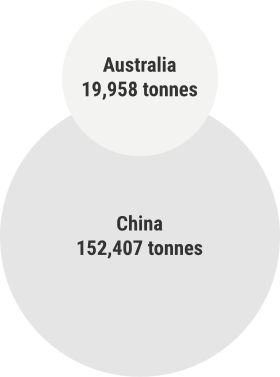
Australia could be one of the main beneficiaries of this dramatic increase in demand, where private companies and local governments alike are eager to expand the country’s nascent rare earths production. In 2021, Australia produced the fourth-most rare earths in the world. It’s total annual production of 19,958 tonnes remains significantly less than the mammoth 152,407 tonnes produced by China, but a dramatic improvement over the 1,995 tonnes produced domestically in 2011.
The dominance of China in the rare earths space has also encouraged other countries, notably the US, to look further afield for rare earth deposits to diversify their supply of the increasingly vital minerals. With the US eager to ringfence rare earth production within its allies as part of the Inflation Reduction Act, including potentially allowing the Department of Defense to invest in Australian rare earths, there could be an unexpected windfall for Australian rare earths producers.
