
Feature
Accelerating diagnosis and drug development with better managed datasets
Andrew Wyatt, digitalisation expert at Sapio Sciences, discusses how LIMS is transforming data management and boosting efficiency in tech-driven research and clinical labs.
Powered by


With the increasing digitalisation of research, facilities are experiencing steady growth in data volumes, resulting in a growing need for scalable storage solutions. Video credit: riaz-baloch / Pixabay
Feature
Accelerating diagnosis and drug development with better managed datasets
Andrew Wyatt, digitalisation expert at Sapio Sciences, discusses how LIMS is transforming data management and boosting efficiency in tech-driven research and clinical labs.

Bio-chips hold great potential to evolve healthcare areas such as home-testing and personalised medicine. Credit: Wladamir Bulgar / SCcience Photo Library / Getty Images

Given the intimacy of neural data, Democratic senator Chuck Schumer and other observers believe that regulation needs to get ahead of the curve before the likes of brain-computer interface (BCI) technology hits the mainstream. Credit: MF3D / Getty Images
Every aspect of science and research is based on data, and across the globe, labs are producing more data than the average person can even comprehend.
With the increasing digitalisation of research, facilities are experiencing steady growth in data volumes, bringing with it a need for scalable storage solutions.
A Laboratory Information Management System (LIMS) is software used by laboratories to create a central repository for storing, managing and accessing data.
As well as storing all essential data relating to samples and results, a LIMS can automate digital processes. This helps labs to optimise workflows, minimise human error, and efficiently analyse large amounts of complex data.
The result? Faster diagnosis times and development of new drugs.
Managing research and clinical data
Data is one of the most prized and valuable assets of a pharma, biotech, research or clinical laboratory. Therefore, the system used to collect, manage and analyse that data needs to be extremely robust, offering secure storage and flexible reporting capabilities. It’s also important to be able to accurately analyse and manage samples, enabling the lab to carry out its core functions.
Historically, laboratories used spreadsheets to manage data and reporting.
This is simply no longer sufficient to meet the demands of modern laboratories; as well as being complicated, it’s time-consuming and prone to error. When labs are dealing with the personal data of hundreds of thousands of patients, it’s vital these standards are met.
Whilst data management systems exist in all industries, implementing one that is specifically designed for use by labs helps to ensure the immediate availability of all necessary data and security functions.
LIMS solutions can handle the large volumes of data created by labs while being reliable and scalable to cope with changing output requirements. They also offer versatile tools with automation capabilities for data monitoring, analysis and reporting.
Benefits of a LIMS
The main purpose of a LIMS is to improve data efficiency and accuracy by reducing manual operations.
It does this by managing large volumes of data quickly and efficiently whilst maintaining strict industry standards for laboratory data management.
Not only that, LIMS enables the automation of complex data analysis, reducing the need for repetitive lab data tasks, freeing up the time of skilled scientists for more skilled tasks.
An efficient LIMS can integrate seamlessly with other essential systems, which is vital for a lab to run smoothly. The best piece of equipment is useless to clinicians if it cannot be used in conjunction with other necessary technology.
Critically, a LIMS creates a single point of access to ensure data consistency, improving overall data quality and security across an organisation.
What is LIMS used for?
Some of the most common tasks supported by LIMS are:
- Sample management: Modern labs often deal with huge numbers of samples that need to be analysed, and manual processes are susceptible to errors and delays. LIMS solutions help to track and trace individual samples by generating a barcode that technicians, at various stages of testing and analysis, can scan to retrieve existing details or record additional information.
- Workflow management: High-quality, traceable results are essential to the success of any lab. By combining all your data in a single location that integrates with a wider network of collaborators, a LIMS empowers laboratories to better manage workflows, improve communication and increase outputs.
- Materials management: Lab processing relies heavily on tracking materials used, typically reagents. A LIMS enables detailed monitoring of inventoried reagents, how much is on hand, lot numbers, expiration dates and reorder levels. Traditional stock management systems are designed for simple warehousing and distribution applications but aren’t able to keep up with the complex laboratory environment. A LIMS allows for complete visibility of the entire lab, including fridges, multiple lab locations and disposal bins, as well as recording where a particular reagent lot was used and with what samples it was combined.
- Inventory management: Laboratories are consistently under pressure to reduce their running costs while also maximising productivity. One of the most effective ways to do this is by improving inventory management, helping your lab to not only track resources but also to use them as efficiently as possible. The LIMS system supports the management of lab consumables, alerting you to low stock, preventing duplicate orders and managing shopping lists to minimise downtime and reduce costs.
- Request management portal: A LIMS supports wider collaboration by making it easy to request, send, and receive samples through the integrated request portal. Authorised researchers and physicians can then securely track and access samples to improve and extend your research team.
Keeping up with an evolving landscape
Just like the fast-paced industries that use them, laboratory information management systems are continually evolving.
Digitalisation is having a major impact on biotech and pharma businesses managing research and clinical labs, especially when combining LIMS to manage lab operations, ELNs (Electronic Lab Notebooks) to document experimental processes, and SDMS (Scientific Data Management Systems) to handle data resulting from experiments.
GlobalData’s business fundamentals senior analyst Ophelia Chan says: “Oncology continued to dominate as the leading therapeutic area for IPOs this year, highlighted by CG Oncology’s $437m upsized IPO—the largest and first of the year. The company’s robust clinical data and ability to secure substantial capital have contributed to its strong performance in 2024.”
After a quiet summer, the IPO market reached full swing in autumn when Bicara Therapeutics, Zenas BioPharma, and MBX Biosciences all opened on the NASDAQ on the same Friday in September. The ‘triple-header event’ saw the three companies pull in over $700m combined. It was no surprise that the surge in activity came after the Federal Reserve’s decision to lower interest rates for the first time in years, ushering in a more inviting funding environment. This fruitful month was a stark contrast to August, which saw a significant global stock market dip amid fears of a US recession.
In June, Telix Pharmaceuticals – an emerging player in the fast-growing radiopharmaceutical space – pulled a last-minute plug on its IPO. The Australian company had been planning to list on NASDAQ and was on course to raise $232m – a value that would have placed it high on the list of biotech IPO sizes this year. Telix cited that its board did not move forward with the plans due to market conditions at the time.

On The Ground International assists Venezuelan caminantes (pictured) between Pamplona and La Laguna, Santander, Colombia. Credit: On The Ground International / Facebook

The Smart Clinic in La Guajira, Colombia. Credit: Siemens Healthineers
Numb feet, bleeding legs and dehydrated bodies mark their journeys – not to mention infectious diseases and psychological trauma. Studies have identified outbreaks of measles, diphtheria and malaria across Venezuela, while tuberculosis, typhoid and HIV, are also resurgent.

Caption. Credit:

Once we see where those changes are, we can plan where we’re going to cut the bone.
Dr Lattanza

Phillip Day. Credit: Scotgold Resources
Total annual production
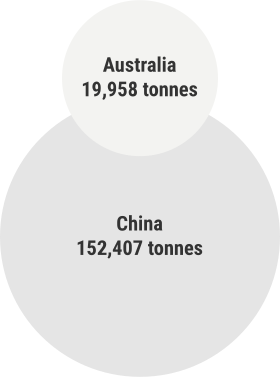
Australia could be one of the main beneficiaries of this dramatic increase in demand, where private companies and local governments alike are eager to expand the country’s nascent rare earths production. In 2021, Australia produced the fourth-most rare earths in the world. It’s total annual production of 19,958 tonnes remains significantly less than the mammoth 152,407 tonnes produced by China, but a dramatic improvement over the 1,995 tonnes produced domestically in 2011.
The dominance of China in the rare earths space has also encouraged other countries, notably the US, to look further afield for rare earth deposits to diversify their supply of the increasingly vital minerals. With the US eager to ringfence rare earth production within its allies as part of the Inflation Reduction Act, including potentially allowing the Department of Defense to invest in Australian rare earths, there could be an unexpected windfall for Australian rare earths producers.
