









Analyst Comment
Sexual health testing stagnant in US despite calls for increased screening
Equality on sexual and reproductive care regardless of sexual orientation and race is vital for improving sexual health.
Powered by







When underserved communities face more funding cuts, a vulnerable population will remain vulnerable.
Analyst Comment
Sexual health testing stagnant in US despite calls for increased screening
Equality on sexual and reproductive care regardless of sexual orientation and race is vital for improving sexual health.
Powered by

When underserved communities face more funding cuts, a vulnerable population will remain vulnerable. Credit: New Africa/Shutterstock.com
World Sexual Health Day, observed annually on 4 September, highlights an important annual theme. In 2025, the theme is Sexual Justice: What Can We Do? It covers sexual health and reproductive rights for all, freedom from stigma and shame, and access to accurate, uncensored information about sexuality and health.
In 2023, the US Centers for Disease Control and Prevention (CDC) reported 2,459,140 cases of syphilis, gonorrhea and chlamydia – a 1.8% decrease from 2022 but a 32.5% rise since 2014. 48.2% of cases involved young adults and teens aged between 15 and 24. Gay and bisexual men, and men who have sex with men, are disproportionately affected by sexually transmitted infections (STIs) compared to other groups. STIs also impact Black and Indigenous communities more than other racial groups, and in 2023, 32.4% of all cases of chlamydia, gonorrhea, and primary and secondary syphilis were in the non-Hispanic Black or African American population.
Emphasis on equality in sexual and reproductive care regardless of sexual orientation and race is therefore vital for improving sexual health in the US. According to GlobalData’s Sexual Health Tests Stock Keeping Unit Tracker, a tracker that analyses purchasing records from 4,350 US hospitals, the most popular targets tested in the US are chlamydia and gonorrhea (CT/NG) as a dual test, with Roche’s Cobas test leading, accounting for 44.6% of total volume sales in 2025, and Hologic’s Aptima Panther tests making up 41.7%. When comparing the volume of sales from the first half (H1) of 2024 to H1 2025 for CT/NG dual tests, it decreased 1.7%, and when looking at total value, it also declined 1.8%. Specifically, the volume of sales, tracked by GlobalData’s Sexual Health Tests SKU Tracker, noted an 8.5% decrease in sales of the Hologic Panther Aptima CT/NG test and a 4.6% increase in sales for the Roche Cobas CT/NG test. Another popular sexual health test target, bacterial vaginosis, has also seen a volume sold decrease of 27.8% comparing H1 2024 and H1 2025.
Ongoing cuts to programmes funding STI testing, such as Planned Parenthood and organisations that serve marginalised communities, along with the decline in safe sex education, may have contributed to the overall decrease in testing. The reduction in testing could be even more pronounced in clinics that have decreased funding. When underserved communities, that desperately need more funding to combat illnesses outside of just sexual health, face more funding cuts, we have a vulnerable population that will remain vulnerable.
Challenges of using AI
The AI-automated IVF procedure faces several challenges that need to be addressed for it to become a standard practice. In a recent case involving a 40-year-old woman who had previously experienced a failed IVF attempt, the automated procedure took nearly ten minutes per egg, which is longer than the standard manual ICSI time. While the automated system successfully fertilised four out of five eggs and led to the birth of a healthy infant, the process involved 23 individual steps and required significant operator involvement. The average time for key tasks such as identifying and stabilising an egg was notably longer than manual methods. Despite these current limitations, researchers believe that advances in technology and increased autonomy will help reduce procedure times and improve efficiency. This ongoing development is crucial for enhancing the accessibility and effectiveness of assisted reproductive technologies (ART) in the future.
GlobalData’s business fundamentals senior analyst Ophelia Chan says: “Oncology continued to dominate as the leading therapeutic area for IPOs this year, highlighted by CG Oncology’s $437m upsized IPO—the largest and first of the year. The company’s robust clinical data and ability to secure substantial capital have contributed to its strong performance in 2024.”
After a quiet summer, the IPO market reached full swing in autumn when Bicara Therapeutics, Zenas BioPharma, and MBX Biosciences all opened on the NASDAQ on the same Friday in September. The ‘triple-header event’ saw the three companies pull in over $700m combined. It was no surprise that the surge in activity came after the Federal Reserve’s decision to lower interest rates for the first time in years, ushering in a more inviting funding environment. This fruitful month was a stark contrast to August, which saw a significant global stock market dip amid fears of a US recession.
In June, Telix Pharmaceuticals – an emerging player in the fast-growing radiopharmaceutical space – pulled a last-minute plug on its IPO. The Australian company had been planning to list on NASDAQ and was on course to raise $232m – a value that would have placed it high on the list of biotech IPO sizes this year. Telix cited that its board did not move forward with the plans due to market conditions at the time.

On The Ground International assists Venezuelan caminantes (pictured) between Pamplona and La Laguna, Santander, Colombia. Credit: On The Ground International / Facebook

The Smart Clinic in La Guajira, Colombia. Credit: Siemens Healthineers
Numb feet, bleeding legs and dehydrated bodies mark their journeys – not to mention infectious diseases and psychological trauma. Studies have identified outbreaks of measles, diphtheria and malaria across Venezuela, while tuberculosis, typhoid and HIV, are also resurgent.

Caption. Credit:

Once we see where those changes are, we can plan where we’re going to cut the bone.
Dr Lattanza

Phillip Day. Credit: Scotgold Resources
Total annual production
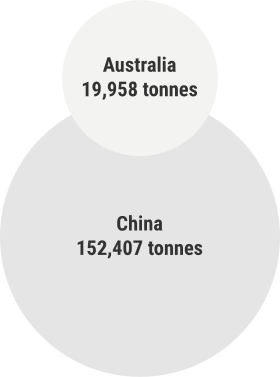
Australia could be one of the main beneficiaries of this dramatic increase in demand, where private companies and local governments alike are eager to expand the country’s nascent rare earths production. In 2021, Australia produced the fourth-most rare earths in the world. It’s total annual production of 19,958 tonnes remains significantly less than the mammoth 152,407 tonnes produced by China, but a dramatic improvement over the 1,995 tonnes produced domestically in 2011.
The dominance of China in the rare earths space has also encouraged other countries, notably the US, to look further afield for rare earth deposits to diversify their supply of the increasingly vital minerals. With the US eager to ringfence rare earth production within its allies as part of the Inflation Reduction Act, including potentially allowing the Department of Defense to invest in Australian rare earths, there could be an unexpected windfall for Australian rare earths producers.
