
Feature
Navigating PFAS bans and regulation compliance in medical plastics
The PFAS debate is moving from theory to practice, with regulators aiming to curb the use of harmful small‑molecule PFAS while preserving materials vital to life‑saving devices. Bernard Banga explores the impact.
Powered by


Main video supplied by Pavel_dp/Creatas Video+ / Getty Images Plus via Getty Images
Cover Story
Precision in paradise: the Dominican Republic emerges as Latin America’s medtech hub
The Dominican Republic is emerging as a strategic nearshoring hub for the US, driven by a rapidly expanding medical device manufacturing sector enjoying industrial free zones, tax incentives and international trade agreements. By Bernard Banga.

Agentic AI in medicine supports multitasking across clinical tools, data and workflows to improve decision-making and efficiency. Credit: Volodymyr Horbovyy / Shutterstock
Per- and polyfluoroalkyl substances (PFAS) occupy a contested space at the intersection of patient safety, materials science and environmental policy. In medical manufacturing, PFAS-based fluoropolymers such as polytetrafluoroethylene (PTFE) remain indispensable for guidewires, catheters, pacemaker leads and vascular grafts.
Their ultra-low coefficients of friction reduce insertion forces in guidewires by as much as 40%, minimising vessel trauma. PTFE resists chemical degradation across a pH range of 2 to 12 and withstands continuous exposure to temperatures up to 260°C without structural changes. Long-term implant studies show that PTFE can function in vivo for 10 to 20 years with minimal degradation.
Yet smaller-molecule PFAS, including PFOA and PFOS, persist in groundwater for years, bioaccumulate in humans and are linked to liver toxicity and endocrine problems. This dual profile – clinical reliability versus environmental persistence – places PFAS at the centre of regulatory debate.
The regulatory sweep: what’s changing
Emerging risks are reshaping how regulators address PFAS, creating engineering and management challenges for medical device manufacturers. Environmental persistence is central to the debate. Fluoropolymers (a class of PFAS) are highly stable, resist chemical breakdown and do not degrade under normal environmental conditions. In the US, the FDA has noted that fluoropolymers are large molecules “too large to cross cell membranes” and “very unlikely to cause toxicity to patients”. A 93-page by ECRI found no conclusive evidence linking PTFE to adverse health effects. In an update on 6 August, 2025, the FDA reaffirmed that it sees “no reason to restrict their continued use in devices”.
Even so, regulators are moving quickly. In the US, several states have enacted disclosure rules and product bans. California’s Senate Bill 682 will prohibit the sale of non-stick cookware containing PFAS by 2030. Minnesota has introduced phased prohibitions on intentionally added PFAS beginning 1 January, 2025. Most state statutes explicitly preserve exemptions for FDA-regulated medical devices, at least in their current drafts.
In Europe, the European Chemicals Agency (ECHA) is advancing a broad restriction proposal under the REACH regulations. Updated 2025 drafts expand sector coverage and tighten concentration thresholds, while negotiations continue “essential use” exemptions for critical sectors. The ECHA’s process envisions a multi-year evaluation that could lead to new restrictions or narrowly defined derogations for essential applications. Reuters and ECHA reports confirm that exemptions for medical and other critical sectors remain under active negotiation, leaving manufacturers facing prolonged regulatory uncertainty in the EU market.

Dominican Republic free zones: key hubs of medical device manufacturing and export. Credit: hyotographics / Shutterstock.com

Bhavik Patel, president, IQVIA Commercial Solutions
Companies are drawn by a combination of favourable tax and customs incentives, along with access to a skilled and cost-competitive workforce, positioning the Dominican Republic as an increasingly attractive destination for medtech investment in the region.
Emerging alternatives to PFAS
While regulatory exemptions provide temporary relief, mounting pressure on PFAS supply chains is accelerating the search for alternatives. Market analysis shows that major suppliers are getting out of PFAS manufacturing altogether. For example, 3M has pledged to end all PFAS production by the close of 2025, having already discontinued or reformulated more than 25,000 products containing PFAS. Milliken had eliminated PFAS-based finishes and fibrers from its textile portfolio by December 2022. These market exits are tightening supply, raising costs and forcing device manufacturers to fast-track approval of alternatives under squeezed timelines.
Against this backdrop, universities, startups and established suppliers are making progress with promising alternatives, though none yet fully replicate the performance profile of fluoropolymers. Thermoplastic polyurethanes (TPU) count among the most likely candidates for catheters and vascular access devices. Research teams at the University of Minnesota have demonstrated TPU compounds which reduce wet friction by about 20% compared to untreated thermoplastics, an important step towards replacing PTFE in high-performance coatings. Early industrial pilots suggest potential for flexible tubing, although biostability and long-term resistance to wear remain significant hurdles.
Biopolymer coatings are gaining traction. Hydromer and other suppliers are developing starch, zein and polylactic acid (PLA) derivatives as resorbable, eco‑friendly coatings for catheters and implants. PLA already represents 32.8% of the biodegradable medical plastics market in 2025, according to USD Analytics, but commercial uptake in medical devices is constrained by mechanical strength, resistance to sterilisation and regulatory approval processes. Inorganic and hybrid coatings offer a third pathway. Companies like Silcotek are trialling silicon-based chemical vapour deposition (CVD) coatings as inert, PFAS‑free alternatives for analytical instruments and certain medical applications where extreme lubricity is not required.Finally, graphene-derived composites are drawing attention as a next-generation option. A May 2025 Forbes report highlighted compostable graphene oxide coatings under investigation for antimicrobial catheters and implantable sensors.

This engine autonomously coordinates and deploys a set of specialist medical AI tools… providing complete and helpful recommendations for individual patient cases.
Dyke Ferber, clinician scientist at the Else Kröner Fresenius Center for Digital Health
Industrial strategies: R&D and supply chains
Medical device manufacturers are responding to regulatory pressure with a coordinated three-pronged strategy encompassing research and development, regulatory engagement and supply-chain resilience. Leading companies such as Medtronic and Baxter International have increased investment in PFAS-free polymer research, with annual R&D budgets reportedly in the tens of millions of dollars. These initiatives focus on approving candidate materials which meet stringent performance demands while reducing environmental and health risks associated with traditional fluoropolymers.
Simultaneously, major firms are actively participating in regulatory consultations to shape workable “essential use” definitions which safeguard medical device exemptions. Abbott Laboratories and Siemens Healthineers have submitted evidence to the European Chemicals Agency (ECHA) and national authorities, pressing for practical timelines and substitution criteria where fluoropolymers are indispensable. These engagements ensure compliance strategies align with evolving EU and US regulations, minimising the risk of unanticipated market disruptions.
Supply-chain resilience is the third critical pillar. Companies such as Boston Scientific and Smith & Nephew are auditing PFAS usage across their manufacturing bills of materials and approving alternative suppliers to mitigate disruptions caused by exiting PFAS producers.
Regulatory compliance: a pragmatic transition
Medical device manufacturers face a dual challenge: ensuring patient safety while complying with increasingly strict PFAS regulations. Regulators are pushing for broad reductions in environmental PFAS release while preserving measured exemptions for applications where device performance or patient safety cannot be compromised.
At the same time, materials innovation is accelerating. Manufacturers can expect incremental alternatives for non-critical coatings in the near term, alongside longer, long-term efforts to produce alternatives which match fluoropolymer performance for essential applications. Early engagement with regulators, robust documentation of essential uses and rigorous testing for biocompatibility and sterilisation compatibility remain crucial to navigating this evolving landscape.
PFAS-free hydrophilic coatings: five pathways
Regulatory scrutiny of PFAS is driving medical device manufacturers to adopt alternative hydrophilic coatings. These surface technologies are advancing rapidly along five distinct pathways. Each is championed by companies seeking to align with FDA and ISO standards while meeting industrial-scale requirements.
- Thermal hydrophilic coatings with FDA validation
Biocoat Inc. (Horsham, Pennsylvania) has patented a 100% PFAS-free thermally applied hydrophilic coating designed for catheter lumens which has demonstrated stable performance in cardiovascular and neurovascular indications. Its compatibility with established industrial processes makes it one of the most advanced PFAS-free solutions.
- UV-curable and polymer composite systems
Hydromer Inc. (Concord, North Carolina) has developed PFAS-free coatings based on ultraviolet (UV)-curable systems and composites such as polyethylene glycol (PEG), polyvinylpyrrolidone (PVP) and chitosan. These chemistries provide broad hydrophilicity and compatibility with various polymer substrates. Evidence of large-scale industrial implementation remains limited.
- Ready-to-deploy lubricious coatings
Harland Medical Systems Inc. (Eden Prairie, Minnesota) has commercialised its Lubricent UV technology, a PFAS-free hydrophilic coating applied to catheters and guidewires. Marketed as highly lubricious and durable, the coating is available for immediate industrial application. Its maturity distinguishes it from technologies still in early development.
- Biomimetic, anti-adhesion coatings
Dutch biotech company LipoCoat BV is pioneering a biomimetic PFAS-free coating which mimics natural lipid barriers. The technology aims to reduce bacterial adhesion without UV curing or added biocides. Although still in preclinical development, the pathway illustrates the potential of bio-inspired surface engineering in next-generation devices.
- Parylene-based dry coatings
Specialty Coating Systems (Indianapolis, Indiana) offers PFAS-free parylene coatings as an alternative to traditional PTFE films. The dry coatings comply with ISO 10993 biocompatibility standards and FDA safety requirements and provide lubrication and biocompatibility in complex geometries where internal space is critical.

Caption. Credit:
Total annual production
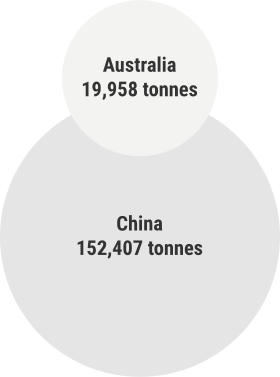
Australia could be one of the main beneficiaries of this dramatic increase in demand, where private companies and local governments alike are eager to expand the country’s nascent rare earths production. In 2021, Australia produced the fourth-most rare earths in the world. It’s total annual production of 19,958 tonnes remains significantly less than the mammoth 152,407 tonnes produced by China, but a dramatic improvement over the 1,995 tonnes produced domestically in 2011.
The dominance of China in the rare earths space has also encouraged other countries, notably the US, to look further afield for rare earth deposits to diversify their supply of the increasingly vital minerals. With the US eager to ringfence rare earth production within its allies as part of the Inflation Reduction Act, including potentially allowing the Department of Defense to invest in Australian rare earths, there could be an unexpected windfall for Australian rare earths producers.
