
Comment
MEDICA returns for 57th edition with packed agenda
The 2025 edition of MEDICA has key focuses on future technologies, women’s health, and regulation, while hundreds of early stage companies will be showcased during the event.
Powered by

Main video supplied by Koonsiri Boonnak/Creatas Video+ / Getty Images Plus via Getty Images
Analyst Comment
Blood deliveries by drone are saving both time and lives
Drone deliveries of medical products, especially blood, are still mostly in a pilot phase.
Powered by

The Civil Aviation Authority has approved a further six-month extension to the airspace approval until 7 October. Credit: StefanIvanovicME/Shutterstock.com
MEDICA, one of the world’s largest medical device industry trade fairs, returns this November with an exciting new edition.
Taking place from 17-20 November at the Messe Düsseldorf Fairgrounds in Düsseldorf Germany, the 57th edition of MEDICA will have a major emphasis on innovation and future-focused healthcare technologies, and the burgeoning start-up ecosystem. With a myriad of events across the four days, including panels, lectures, and educational seminars which demonstrate where innovation in the medical device space and across the broader life sciences ecosystem is headed, there is sure to be something of interest for all attendees.
Featuring 193 sessions spanning topics such as device innovation, women’s health, regulation and artificial intelligence (AI), MEDICA 2025 will highlight critical developments and innovations across medtech segments including remote patient monitoring (RPM), imaging, robotics, diagnostics, and smart hospitals. The agenda will also address some of the key challenges surrounding regulatory compliance, healthcare inequalities, and accounting for laboratory-based staffing shortages.
AI’s application across multiple healthcare disciplines
Artificial intelligence (AI) has become ubiquitous in healthcare, so it should come as no surprise that multiple sessions throughout MEDICA 2025 outline how the technology is improving medical devices, diagnostics, and service provisions across the broader healthcare ecosystem.
Speakers will explore what it takes to deploy AI effectively within healthcare, with guidance around bringing the technology from the research state into real world clinical practice. Further presentations in this vein will home in on the key technical and regulatory considerations towards applying AI in a manner that is both safe and beneficial, and the key approaches towards building trust in AI once it has been deployed across a range of healthcare use cases.
Other sessions will look at AI’s intersection with smart robotics and the technology’s application as a healthcare ‘companion’ in pancreatic surgery, while Microsoft’s chief medical information officer and director of business strategy, Dr Markus Vogel, will highlight how voice interfaces and AI-driven health agents are transforming communication in healthcare.
Regulation
With regulation a mainstay on the European medical device scene in recent years, with the likes of the EU Medical Device Regulation (EU MDR) and EU AI Act at various stages of implementation, navigating compliance with the current regulatory mandates is another key theme at this year’s MEDICA.
Sessions on regulation will reflect on how such mandates affect medical device availability, while researchers from TU Dresden will highlight how cybersecurity risks in connected and AI-driven medical devices can be mitigated as healthcare becomes more digitised, with the researchers providing insight into gaps that exist within current regulation in both the EU and US.
The EU Medical Device Regulation (EU MDR) has resulted in confusion from some medical device manufacturers around how to satisfy the regulation’s dictates. Attendees will have the opportunity to speak directly with a Notified Body who will shed light on the various requirements for manufacturers to become recertified under the new regime.
Another session will focus on navigating the In Vitro Diagnostic Regulation (IVDR), with insights provided by the Johner Institute’s Dr Sophie Bartsch on how to navigate the requirements of the IVDR and protect against cyber threats.
Special forums highlight women’s health and laboratory medicine hurdles
Peppered throughout MEDICA 2025’s agenda are several tracks that home in on specific topics. This year’s MEDICA Innovation Forum (MIF) is centred on women’s health. Topics in focus will include how gender bias gaps can be closed and healthcare equity improved. Speakers including Dr Antonella Santuccione Chadha, CEO of the Women’s Brain Foundation, will outline how closing the women health gap is as much about enhancing the health of entire societies and economies as women’s health itself. Another session on the MIF track will look at how neurotechnology is bridging the care equity gap by offering non-invasive, drug-free, and clinically validated treatments that are specifically tailored to women’s needs.
Meanwhile, throughout the MEDICA Labmed Forum (MLF), David Petri, head of Lindenburg Academy at University Hospital Cologne, will provide his perspective on the shortage of skilled staff within the European lab community. Other topics in focus on the MLF include the need for young talent in the field, and the role automation has to play due to staffing shortages.
GlobalData’s business fundamentals senior analyst Ophelia Chan says: “Oncology continued to dominate as the leading therapeutic area for IPOs this year, highlighted by CG Oncology’s $437m upsized IPO—the largest and first of the year. The company’s robust clinical data and ability to secure substantial capital have contributed to its strong performance in 2024.”
After a quiet summer, the IPO market reached full swing in autumn when Bicara Therapeutics, Zenas BioPharma, and MBX Biosciences all opened on the NASDAQ on the same Friday in September. The ‘triple-header event’ saw the three companies pull in over $700m combined. It was no surprise that the surge in activity came after the Federal Reserve’s decision to lower interest rates for the first time in years, ushering in a more inviting funding environment. This fruitful month was a stark contrast to August, which saw a significant global stock market dip amid fears of a US recession.
In June, Telix Pharmaceuticals – an emerging player in the fast-growing radiopharmaceutical space – pulled a last-minute plug on its IPO. The Australian company had been planning to list on NASDAQ and was on course to raise $232m – a value that would have placed it high on the list of biotech IPO sizes this year. Telix cited that its board did not move forward with the plans due to market conditions at the time.

On The Ground International assists Venezuelan caminantes (pictured) between Pamplona and La Laguna, Santander, Colombia. Credit: On The Ground International / Facebook

The Smart Clinic in La Guajira, Colombia. Credit: Siemens Healthineers
Numb feet, bleeding legs and dehydrated bodies mark their journeys – not to mention infectious diseases and psychological trauma. Studies have identified outbreaks of measles, diphtheria and malaria across Venezuela, while tuberculosis, typhoid and HIV, are also resurgent.

Caption. Credit:

Once we see where those changes are, we can plan where we’re going to cut the bone.
Dr Lattanza

Phillip Day. Credit: Scotgold Resources
Total annual production
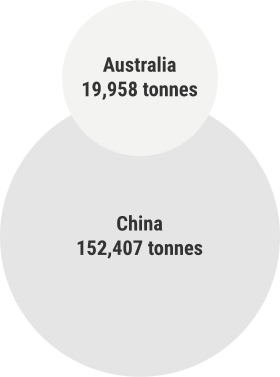
Australia could be one of the main beneficiaries of this dramatic increase in demand, where private companies and local governments alike are eager to expand the country’s nascent rare earths production. In 2021, Australia produced the fourth-most rare earths in the world. It’s total annual production of 19,958 tonnes remains significantly less than the mammoth 152,407 tonnes produced by China, but a dramatic improvement over the 1,995 tonnes produced domestically in 2011.
The dominance of China in the rare earths space has also encouraged other countries, notably the US, to look further afield for rare earth deposits to diversify their supply of the increasingly vital minerals. With the US eager to ringfence rare earth production within its allies as part of the Inflation Reduction Act, including potentially allowing the Department of Defense to invest in Australian rare earths, there could be an unexpected windfall for Australian rare earths producers.
