
Feature
Materialise drives personalised surgery from niche to norm
As healthcare systems increasingly turn to personalised approaches, Belgian company Materialise is accelerating efforts to scale 3D planning and patient-specific surgical solutions across clinical disciplines - aiming to move custom care from niche innovation to standard practice. By Catherine Longworth.
Powered by


Main video supplied by angkhan/Creatas Video+ / Getty Images Plus via Getty Images
Cover Story
Precision in paradise: the Dominican Republic emerges as Latin America’s medtech hub
The Dominican Republic is emerging as a strategic nearshoring hub for the US, driven by a rapidly expanding medical device manufacturing sector enjoying industrial free zones, tax incentives and international trade agreements. By Bernard Banga.

Agentic AI in medicine supports multitasking across clinical tools, data and workflows to improve decision-making and efficiency. Credit: Volodymyr Horbovyy / Shutterstock
At a time when healthcare systems are under pressure to increase efficiency while delivering tailored outcomes, Belgian company Materialise is making a calculated push to bridge that divide.
A longstanding pioneer in 3D printing and surgical planning, Materialise is positioning itself as a central player in the movement toward personalised medicine.
The company, headquartered in Leuven, has been working in medical device planning and production for over three decades. It is now focused on an ambitious objective: enabling personalised surgery to move from a niche solution to a standard part of care across disciplines such as cranio-maxillofacial (CMF) surgery and orthopaedics.
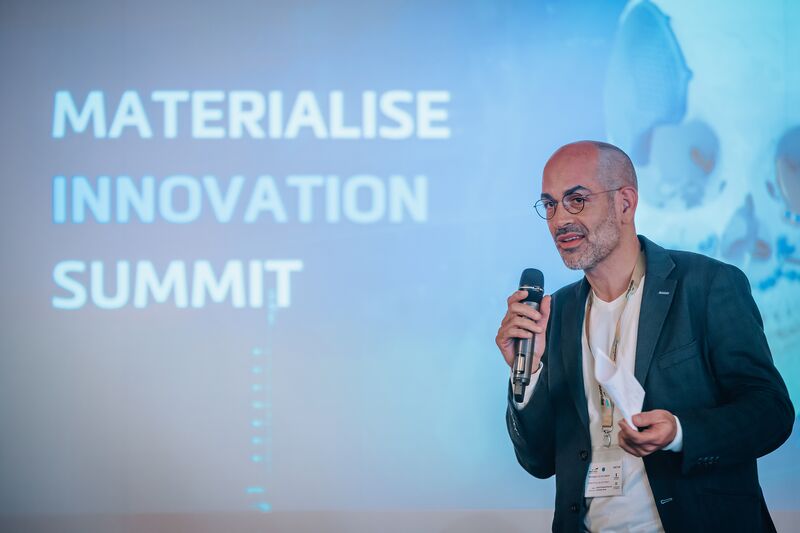
Prof. Thomas Schouman from AP-HP Pitié-Salpêtrière in Paris at the Materialise Innovation Summit in Leuven, Belgium. Credit: Materialise
Speaking at a two-day CMF innovation summit attended by clinicians, engineers and healthcare innovators from across Europe and beyond, Materialise executives outlined both their progress and the work that lies ahead.
“The technology is proven. The challenge now is scale,” said Koen Peters, Head of Materialise Medical. “We know personalised care improves outcomes. The next step is integrating it seamlessly into day-to-day surgical practice across more hospitals, more regions and more types of procedures.”
From early adopters to clinical mainstream
One of the recurring themes at the event was the evolving mindset among clinicians. A decade ago, many surgeons viewed 3D surgical planning as experimental or reserved for complex cases. Today, in several leading medical centres, it has become routine.
“Surgeons are no longer asking whether this works,” shared Peters. “They are asking how to integrate it more efficiently and how to extend access to more patients.”
This shift has been particularly visible in the CMF field. Although relatively small compared to other surgical disciplines, the CMF community is recognised for its openness to innovation. According to Materialise, adoption of 3D planning, personalised implants and digital workflows has accelerated sharply in recent years.
The company credits this in part to a growing network of clinicians who act as peer advocates. Surgeons who have successfully adopted these tools are sharing their experience with colleagues, helping to build trust and dispel hesitation among those still unfamiliar with the technology.
In his keynote address at the summit, Dr Thomas Kofod, Chair of Oral and Maxillofacial Surgery at Rigshospitalet in Copenhagen, disclosed that his department now utilises 3D planning in every procedure and have completed more than 1,000 reconstructions to date.
For Dr Kofod, the full adoption of patient-specific planning and implants has elevated technology from a supplementary aid to an indispensable element of surgical practice. His experience reflects a broader European shift, where digital precision is not displacing surgical skill but augmenting it.
Prof Thomas Schouman of AP-HP Pitié-Salpêtrière, Paris drew on more than ten years’ experience with porous implants in CMF reconstruction. Once regarded as experimental, these materials are now integral to managing complex defects. He presented fresh clinical data demonstrating that porous structures enhance osseointegration while providing greater flexibility in surgical planning.
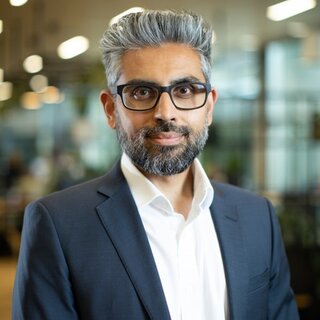
Bhavik Patel, president, IQVIA Commercial Solutions
Ecosystem, not just equipment
Materialise is also careful to position itself not just as a vendor of devices or planning platforms, but as a partner in clinical transformation. The company emphasised the importance of building an ecosystem that supports surgeons both technically and professionally.
“We are not simply offering technology,” said Peters. “We are offering a framework that connects physicians, engineering expertise and digital tools to help deliver better care.”
This ecosystem includes educational forums, collaborative planning services, clinical engineering support and access to real-world case data. Materialise believes this multifaceted approach is essential to building lasting adoption and delivering consistent outcomes.
Central to the company’s offer is what it refers to as a "predictability engine" - a set of tools and processes designed to bring greater certainty to surgical planning and execution. The aim is to make outcomes more consistent, reduce intraoperative uncertainty and simplify the clinical decision-making process.
TMJ, orthopaedics and the broader opportunity
While CMF is an established vertical, Materialise is expanding into other areas. In Europe, Materialise has launched a TMJ total joint replacement system and sees this as a major opportunity for growth.
The company believes the TMJ market is entering a new phase. Earlier generations of implants, introduced in the 1980s and 1990s, often underperformed, leading to caution among surgeons. Now, more advanced solutions, based on personalised planning and improved biomaterials, are offering renewed confidence.
Dr Vladimír Machoň of Charles University, Prague, and Mr Sherif Bayoumi of Spire Manchester Hospital shared practical insights from complex TMJ cases, detailing complications and how personalised implants have helped resolve them.
“These are difficult cases,. But digital planning allows us to anticipate challenges and plan for long-term function," said Machoň.
Bayoumi presented tumor reconstruction cases combining TMJ replacement with free flap reconstruction, demonstrating how personalised implants improve both function and aesthetics. “Patient-specific solutions give us bespoke reconstructions that deliver better cosmetic and functional results,” said Bayoumi.
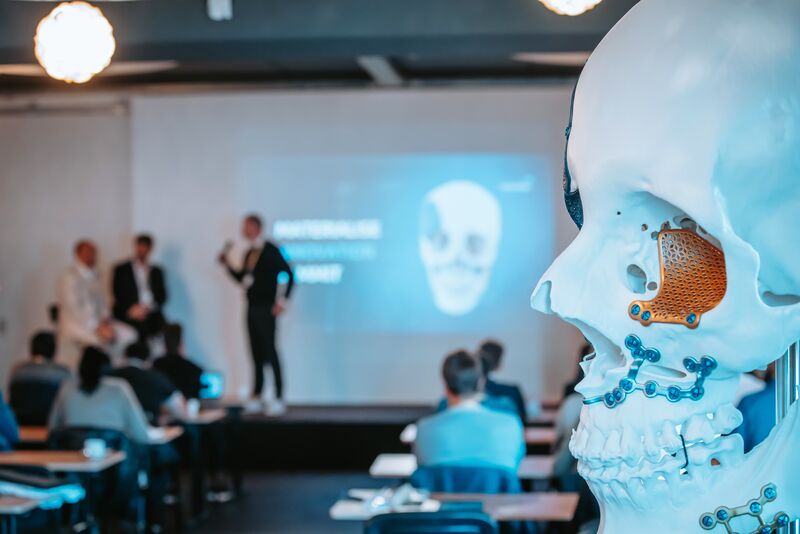
Innovation in focus at the Materialise Summit on 3D-printed, patient-specific surgery. Credit: Materialise
Materialise is also active in orthopaedics and cardiology, where it is applying its experience with planning software, implants and 3D visualisation to new procedures.
“The future of this company will be shaped by its ability to scale personalised care across multiple clinical domains,” said Peters. “It’s not about one product or one field. It’s about enabling a methodology.”
Investment in adjacent technologies
Another area receiving growing attention is the use of extended reality technologies - augmented reality (AR) and virtual reality (VR) - to enhance preoperative planning and intraoperative navigation.
Materialise is currently working with early adopters to test how AR can improve anatomical understanding and surgical confidence. The company views AR as a complementary tool rather than a replacement for existing solutions.
Concluding the summit, Dr. Diego Rossi and Dr. Alessandro Remigio Bolzoni from Milan’s IRCCS Fondazione Policlinico presented findings from one of Europe’s first studies on AR/XR in CMF surgery.
Dr. Rossi shared clinical results on CAD CAM planning, emphasising that while 3D technologies enhance precision, optimal outcomes still depend on the surgeon’s clinical knowledge and aesthetic judgment regarding facial harmony and proportions. Dr. Bolzoni presented promising findings on optimal see-through AR systems, demonstrating real-time visualisation capabilities
“We are now moving beyond the hype,” he said. “Our data show AR and XR potential to enhance accuracy and confidence in real surgical conditions.”

CMF Innovation Summit - September 25-26, in Leuven, Belgium. Credit: Materialise
Materialise Market Manager Maarten Zandbergen explained that while XR won't replace fundamental technologies, it can significantly improve surgeons' visualisation and planning capabilites. "The goal is to make surgery more predictable and outcomes more precise,” he said.
That philosophy - technology in service of outcomes - has become something of a mantra at Materialise. The company is careful to emphasise that it does not pursue innovation for its own sake. Instead, it focuses on aligning technological capability with clearly defined clinical needs.
Operational challenge of growth
With growth comes pressure to scale operations. Internal figures suggest that Materialise’s personalised solutions are growing at more than three times the average rate of the CMF market. That level of growth requires expansion of manufacturing, clinical support and education programmes.
Peters described this not just as a challenge, but as an opportunity to refine how the company operates. As more hospitals seek to bring personalised planning into their workflows, the company is investing in point-of-care partnerships that enable healthcare providers to adopt parts of the planning process in-house, supported by the company’s software and platforms.
Confidence heading into 2026
As the year draws to a close, Materialise leadership appears confident. Peters noted that the company is on track to finish 2025 strongly, with a clear strategy for the coming year.
“We are well-positioned for 2026,” Peters shared. “The growth in personalisation is validating our approach, but it also pushes us to keep improving - to keep listening to surgeons, expanding our ecosystem and delivering tools that make a real difference in the operating room.”
In an industry where innovation is often incremental, Materialise is making a case for scale. By combining engineering expertise with clinical collaboration and a clear focus on outcomes, the company is attempting something few others have done: to turn personalised surgery from a specialist solution into a mainstream standard of care.
KPI / Item | Pre-digital baseline / Annual cost w/o monitoring | With monitoring (2025 median) | Impact / Savings |
Alert-to-action time | 5–7 days | < 24 hours | Faster response |
Expedite shipments (per month) | 12 | 4 | Reduced by 66% |
Stockout days (per quarter) | 6–8 days | 1–2 days | Improved continuity |
ROI (Resilinc case study) | n/a | “Millions saved” (undisclosed) | Positive impact |
Expedite airfreight | $3.5m | $1.0m | $2.5m saved |
Production downtime | $2.0m | $0.7m | $1.3m saved |
Platform subscription (avg.) | — | $0.8m | — |
Net impact | — | — | +$3.0m |

Failure to ensure the US government and healthcare providers in the US have the same information as our European counterparts poses a risk to providers, patients, caregivers and consumers in the US.
Michelle Tarver, director of the FDA’s Center for Devices and Radiological Health (CDRH)

Caption. Credit:
Total annual production
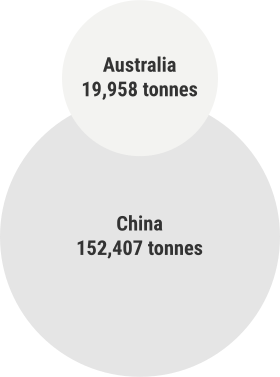
Australia could be one of the main beneficiaries of this dramatic increase in demand, where private companies and local governments alike are eager to expand the country’s nascent rare earths production. In 2021, Australia produced the fourth-most rare earths in the world. It’s total annual production of 19,958 tonnes remains significantly less than the mammoth 152,407 tonnes produced by China, but a dramatic improvement over the 1,995 tonnes produced domestically in 2011.
The dominance of China in the rare earths space has also encouraged other countries, notably the US, to look further afield for rare earth deposits to diversify their supply of the increasingly vital minerals. With the US eager to ringfence rare earth production within its allies as part of the Inflation Reduction Act, including potentially allowing the Department of Defense to invest in Australian rare earths, there could be an unexpected windfall for Australian rare earths producers.
