
Feature
Inside the engine room of medtech innovation
At this year’s MEDICA convention in Düsseldorf, Germany, innovation across the medical device and IVD industries was on full display, writes Ross Law.
Powered by

Main video supplied by tan stock studio/Creatas Video via Getty Images
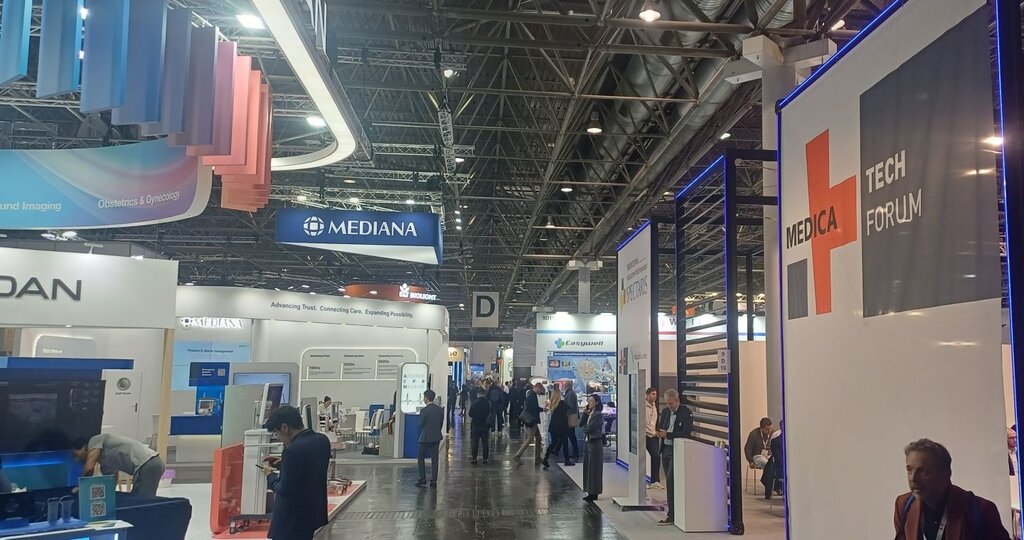
Walking the myriad halls of the MEDICA convention gives a palpable sense of the innovation bursting at the seams of the medical device industry.
From in vitro diagnostics (IVD) to novel technologies and advanced applications of AI across multiple imaging modalities, the convention, which took place on 17-20 November in Düsseldorf, Germany, offered attendees a widescreen view of the key innovation trends shaping the medical device industry.

Credit: Ross Law/GlobalData.
Focal areas of innovation for the medical device industry including diagnostics, treatment protocols, and the application of evolving technologies, all have the aim to improve patient outcomes.
Medical Device Network (MDN) highlights some of the key innovations observed at this year’s convention.
The first CE-marked AI software for ovarian cancer detection
The use of AI is gaining a huge amount of traction in the healthcare space, particularly in medical imaging. According to GlobalData analysis, AI’s application in healthcare is forecast to reach a valuation of around $19bn by 2027, with the global diagnostic imaging space forecast to reach a valuation of $81.4bn by 2034, up from $52.8bn in 2024.
University of Turin spinout SynDiag’s offering aims to advance decisioning support for the early detection of ovarian cancer. OvAi, the company’s software as a medical device (SaMD), is claimed to be the first EU CE-marked tool to aid in detecting ovarian lesions.
According to the American Cancer Society, ovarian cancer is particularly hard to find early since it typically does not cause symptoms until it reaches an advanced stage, while pelvic exams are often unable to detect small tumours in the ovaries.
SynDiag’s software uses AI to analyse ultrasound videos to identify anatomical features of ovarian tumours and highlight them for clinicians.
Speaking to MDN, SynDiag’s CEO Daniele Conti said OvAi’s key aim is to standardise gynaecological ultrasound examinations.
Conti commented: “Today, the exam is variable, and largely dependent on the experience of an operator and the pelvic regions that are being looked at.
“The overall aim of our software is not to provide a diagnosis for ovarian cancer, but rather to provide an objective anatomical description. This means that, via our software, whoever is doing the exam will obtain a description of any lesion present in the ovaries in a very standardised, mathematical way, and according to international guidelines.”
A novel treatment for osteoarthritis
During the convention, MDN met up with Allegro CEO Lucas Decuypere. The Belgian company is developing Hydrocelin, an injectable microparticle hydrogel to treat osteoarthritis, a joint disease that most commonly affects the knee.
The underlying cause of osteoarthritis, for which there is no cure, is a disruption of the mechanical function of the synovial fluid. The condition is a leading cause of disability worldwide.
Decuypere explained: “Our technology is designed to increase the shock absorbing potential of the synovial fluid, which decreases in the case of osteoarthritis.
“As a result of injecting millions of microparticles, our technology brings the shock absorbing potential of the synovial fluid back to its original level.”
Credit: Ross Law/GlobalData.
According to Allegro’s pre-clinical data, the treatment takes immediate effect upon injection, with patients having to receive annual doses thereafter to maintain its effect
The company has completed its pre-clinical package, which Decuypere said showed a strong safety profile.
Decuypere added: “We’ve also done extensive testing on large animal models that has shown that we are able to effectively treat osteoarthritis, so the animals are lame-free after they get the treatment.
“We are now preparing for human clinical trials, which we anticipate initiating in the coming months.”
Saliva-based pregnancy tests
Salignostics has developed Salistick, a pregnancy test that uses saliva samples to determine if a woman is pregnant. The Israeli company attended Medica fresh from Salistick’s commercial launch in Germany, adding to its existing European presence in countries including the UK and Poland.
Salignostics was spun out of the Hebrew University of Jerusalem in 2017 by five co-founders, including CEO Dr Guy Krief, who were experts in saliva research.
Salistick uses the recombinant beta hCG (rhCG) as a biomarker – a hormone that is essential for establishing and maintaining pregnancy.
Salignostics’ initial challenge was in devising a way or revealing this biomarker in saliva, since during the company’s R&D, it realised that the fluid had a masking effect. The device consists of a detector and a microfluidics chamber, the technology of which reveals the biomarker.
“On the one end, saliva gets in. On the other, you get a filtered, clean sample ready to go for the detector. That’s how it works with all assays,” Krief told MDN.
Beyond pregnancy testing, Salignostics is also developing its technology to diagnose conditions including Strep A and HIV – all of which use the same rhCG as a biomarker.
Krief explained: “RhCG reflects not only the oral cavity, but the entire body situation, reflecting hormones, viral infection, bacteria and a range of other measures.”
The design of the device makes it easy to add in testing strips for other indications.
Krief added: “This gives us the possibility for fast development into other indications.
“All that needs to be done is to change the detector, and the detector can be based on commercial strips or platforms. We don’t need to develop from zero.”
Bringing down language barriers in healthcare
Not all innovations showcased at MEDICA 2025 centred on devices with direct treatment applications. Pocketalk was in attendance to exhibit its instant translation device that is designed to facilitate a two-way conversation between people that speak different languages.
According to the UK Government’s Office for National Statistics (ONS), one million people in the UK are unable to speak English well, or at all.
In May 2025, the UK’s National Health Service (NHS) outlined a framework for improving translation and interpretation services, acknowledging that these services within the NHS remain fragmented.
With 92 languages available, Pocketalk’s device, also named Pocketalk, features a screen and microphone. When users speak into the device, it translates their voice into their chosen language and displays the translated text on screen.
Pocktalk’s business development manager Matt Steel highlighted that in the case of the UK, there is a growing need for translation tools in areas that were previously less accustomed to migration and the ensuing language barriers this is leading to within healthcare settings.
Steel told MDN: “Taking the UK as an example, the dispersion of people that speak different languages is becoming greater.
“What we’re experiencing is that people are coming to the UK and living in places such as Devon or Norfolk. Historically, a wide range of different languages beyond English have not been spoken in these areas of the country, making the language barrier a challenge being experienced in healthcare settings on a more regular basis.”
Challenges around meeting the EU IVDR
Amid the innovation on display at MEDICA, meeting compliance with the EU’s In Vitro Diagnostic Regulation (IVDR) is causing challenges for certain companies involved in the IVD space. A presentation during the convention highlighted that ongoing uncertainty around IVDR certification is having a detrimental effect on innovation in Europe.
In July 2024, the EU extended the date IVD’s in Europe must be certified under the IVDR to December 2029 for lower risk IVDs and 2028 and 2027 for medium- and high-risk IVDs, respectively. Those without certification for their IVDs by the required dates will lose European market access for their products.
MDN spoke with Notified Body DNV to learn more about the challenges being faced by those seeking IVDR certification.
Molly Rogers, DNV’s head of IVDR for Medical Europe, highlighted that the issues for manufacturers who are less far along in the IVDR certification process tend to centre on the amount of time it takes to engage with and get their applications reviewed by a Notified Body and schedule the likes of audits.
Rogers said: “This is especially true under the IVDR, given that the majority of manufacturers were previously self-declared.
“They never have to even look at a Notified Body before, with nobody ever having objectively looked at their technical file or rejected their IVD’s intended purpose or anything like that.”
According to Rogers, companies with smaller regulatory teams are the most likely to be having difficulty in becoming IVDR certified. Rogers shared that the issue of resource allocation becomes especially pronounced for companies DNV has seen that may not yet have their quality management systems (QMS) up to scratch. This being the case, these companies also need to allocate resources towards meeting ISO standard 13485 before they can address meeting the IVDR’s requirements.
Rogers added: “Smaller companies may not have the resources in regulatory affairs, the experience of what it’s like to interface with Notified Bodies, and to understand the requirements for the technical documentation and the nuances around it.”
Rogers’ view is that despite the revised IVDR implementation timelines, there is an underestimation for how soon time can evaporate. She advises that manufacturers do not delay in figuring out what they need to do to become IVDR certified.
“We urge manufacturers to engage with their Notified Body, and to not say, ‘we’ll deal with that next year’,” she stressed.
“Notified Bodies can provide feedback on classification and purpose and how these factors apply for their devices. Just having that engagement first will dictate manufacturers’ regulatory strategy moving forward.”
This year’s MEDICA proved to be a huge showcase for innovation in the medical device space within Europe and the wider world. While challenges around regulation exist, it seems clear that innovation in the medical device industry is continuing to advance at pace across a multitude of healthcare disciplines.

The Smart Clinic in La Guajira, Colombia. Credit: Siemens Healthineers
Numb feet, bleeding legs and dehydrated bodies mark their journeys – not to mention infectious diseases and psychological trauma. Studies have identified outbreaks of measles, diphtheria and malaria across Venezuela, while tuberculosis, typhoid and HIV, are also resurgent.

Caption. Credit:

Once we see where those changes are, we can plan where we’re going to cut the bone.
Dr Lattanza
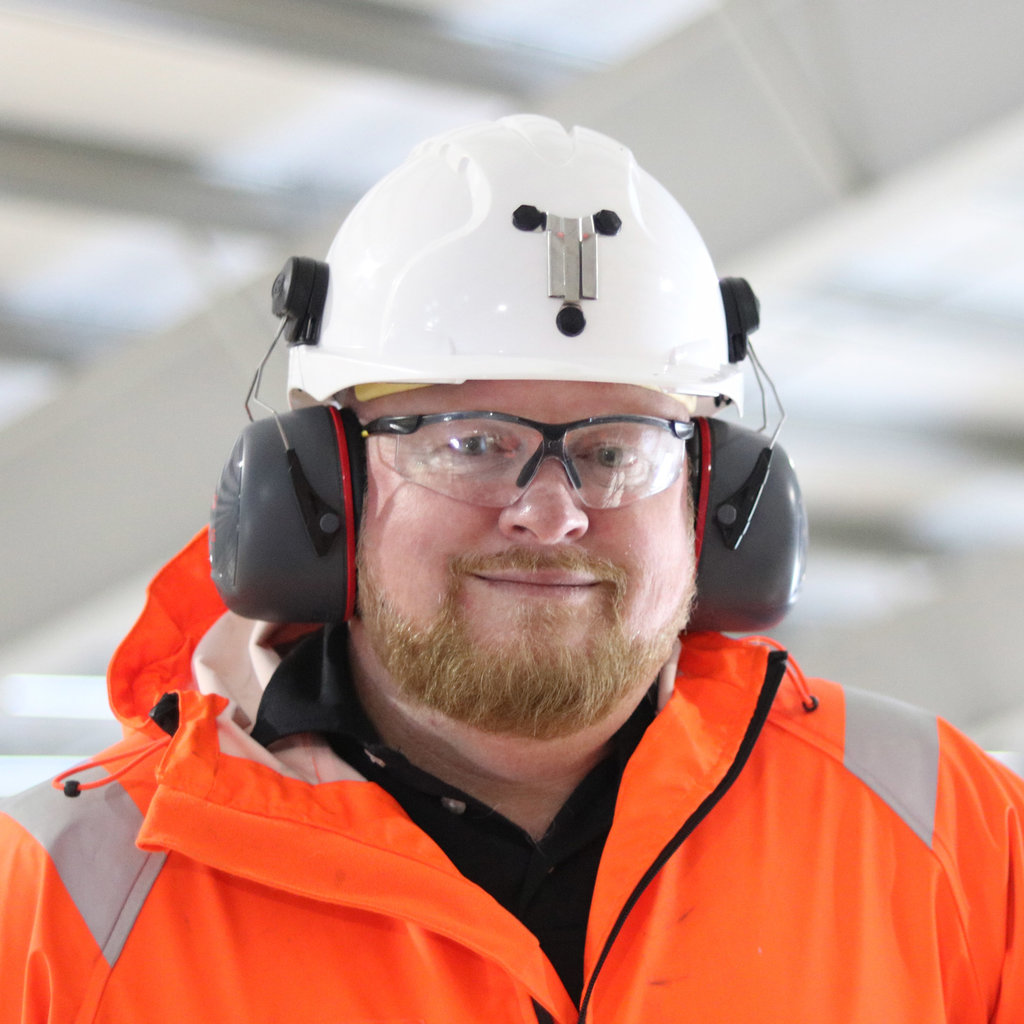
Phillip Day. Credit: Scotgold Resources
Total annual production
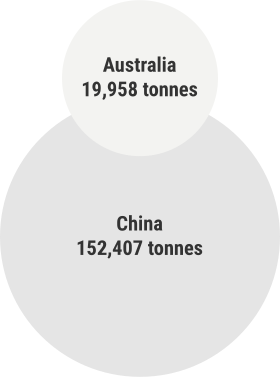
Australia could be one of the main beneficiaries of this dramatic increase in demand, where private companies and local governments alike are eager to expand the country’s nascent rare earths production. In 2021, Australia produced the fourth-most rare earths in the world. It’s total annual production of 19,958 tonnes remains significantly less than the mammoth 152,407 tonnes produced by China, but a dramatic improvement over the 1,995 tonnes produced domestically in 2011.
The dominance of China in the rare earths space has also encouraged other countries, notably the US, to look further afield for rare earth deposits to diversify their supply of the increasingly vital minerals. With the US eager to ringfence rare earth production within its allies as part of the Inflation Reduction Act, including potentially allowing the Department of Defense to invest in Australian rare earths, there could be an unexpected windfall for Australian rare earths producers.
