Anaylst Comment
J&J’s potential neurovascular exit: implications for market dynamics
The neurovascular market, estimated at $4.2bn in 2024 by GlobalData, is becoming increasingly specialised and competitive.
Powered by


J&J’s potential exit from the neurovascular market follows a trend among medtech leaders such as Medtronic and Stryker. Credit: Michael Vi / Shutterstock
The Financial Times recently reported that Johnson & Johnson (J&J) is considering the sale of Cerenovus, its neurovascular division. This aligns with a broader industry trend where companies are shifting toward high-growth, high-margin markets, and focusing resources on areas with higher perceived growth potential.
The neurovascular market, estimated at $4.2bn in 2024 by GlobalData, is becoming increasingly specialised and competitive. Major players such as Stryker, Medtronic, and Terumo control about 68% of the global neurovascular market, making it challenging for mid-sized companies such as Cerenovus to scale effectively. J&J’s acquisitions of Abiomed for $16.6bn, Shockwave Medical for $13.1bn, and V-Wave for $1.7bn highlight a commitment to the cardiovascular interventions sector, which is expected to outpace the neurovascular market.
The success of neurovascular interventions relies on rapid device application, as effective treatment must occur within minutes to hours of symptom onset. This time constraint limits market growth despite the rising demand for stroke treatment. To succeed in this market, companies must go beyond technological innovation. As stroke care evolves, improving treatment protocols, accelerating the adoption of new devices, and expanding access to life-saving interventions are critical. A multi-pronged approach is key to growing the neurovascular market, shifting toward faster, more efficient solutions to meet increasing demand. While larger, more established players with significant market share are likely to lead these innovations, this dynamic also creates opportunities for disruptive competitors to tap into underdeveloped market segments.
J&J’s potential exit from the neurovascular market follows a trend among medtech leaders such as Medtronic and Stryker, which have refocused on high-growth markets. Medtronic divested its patient monitoring and respiratory businesses to concentrate on core markets, while Stryker expanded through acquisitions in digital surgery and neurovascular care. J&J’s potential move reflects a similar strategy to strengthen its position in cardiovascular care.
While this shift could provide short-term financial benefits, it risks limiting J&J’s ability to capitalise on the growing demand for advanced stroke care. Medtronic, Stryker, and Terumo have successfully invested in both the cardiovascular and neurovascular markets. Terumo strengthened its neurovascular portfolio with the 2016 acquisition of Sequent Medical and its innovative WEB aneurysm treatment device. While the cardiovascular market remains Terumo’s primary revenue driver, its ongoing investment in the neurovascular market has enabled it to capture new growth opportunities and monopolise the emerging intrasaccular flow device sector.
With the ageing population and rising stroke rates, health systems are increasingly prioritizing stroke interventions and expanding access to thrombectomy procedures. Additionally, AI is transforming stroke care, improving detection and triage. These developments make neurovascular care an attractive long-term opportunity for companies investing in these advancements.
Ultimately, J&J’s potential exit could provide short-term financial gains, but it may forfeit long-term growth in the evolving neurovascular sector. As J&J shifts resources to cardiovascular care, competitors such as Medtronic, Stryker, and Terumo may strengthen their foothold in neurovascular care, shaping the future of stroke care.
Advancing neuroimaging for Alzheimer’s diagnosis
Neuroimaging is critical for Alzheimer’s disease management as it enables earlier and more accurate diagnoses through the detection of biomarkers such as β-amyloid plaques and tau protein. Lantheus’s acquisition of LMI brings new neuroimaging assets into its portfolio, including NeuraCeq (florbetaben F 18 injection), an FDA-approved positron emission tomography (PET) agent designed to identify β-amyloid plaques, and ADvance (PI-2620), a tau PET agent in late-stage clinical development. These additions complement Lantheus’s existing neuroimaging pipeline, which includes NAV-4694, a β-amyloid agent acquired from Meilleur Technologies in 2024, and MK-6240, a tau imaging agent acquired from Cerveau Technologies in 2023. NeuraCeq competes with established products such as Eli Lilly’s Amyvid (florbetapir F 18 injection) and GE Healthcare’s Vizamyl (flutemetamol F 18 injection), while ADvance is poised to strengthen Lantheus’ position in the growing tau-based imaging market. These acquisitions position Lantheus as a strong player in Alzheimer’s disease diagnostics.
GlobalData’s business fundamentals senior analyst Ophelia Chan says: “Oncology continued to dominate as the leading therapeutic area for IPOs this year, highlighted by CG Oncology’s $437m upsized IPO—the largest and first of the year. The company’s robust clinical data and ability to secure substantial capital have contributed to its strong performance in 2024.”
After a quiet summer, the IPO market reached full swing in autumn when Bicara Therapeutics, Zenas BioPharma, and MBX Biosciences all opened on the NASDAQ on the same Friday in September. The ‘triple-header event’ saw the three companies pull in over $700m combined. It was no surprise that the surge in activity came after the Federal Reserve’s decision to lower interest rates for the first time in years, ushering in a more inviting funding environment. This fruitful month was a stark contrast to August, which saw a significant global stock market dip amid fears of a US recession.
In June, Telix Pharmaceuticals – an emerging player in the fast-growing radiopharmaceutical space – pulled a last-minute plug on its IPO. The Australian company had been planning to list on NASDAQ and was on course to raise $232m – a value that would have placed it high on the list of biotech IPO sizes this year. Telix cited that its board did not move forward with the plans due to market conditions at the time.

On The Ground International assists Venezuelan caminantes (pictured) between Pamplona and La Laguna, Santander, Colombia. Credit: On The Ground International / Facebook

The Smart Clinic in La Guajira, Colombia. Credit: Siemens Healthineers
Numb feet, bleeding legs and dehydrated bodies mark their journeys – not to mention infectious diseases and psychological trauma. Studies have identified outbreaks of measles, diphtheria and malaria across Venezuela, while tuberculosis, typhoid and HIV, are also resurgent.

Caption. Credit:

Once we see where those changes are, we can plan where we’re going to cut the bone.
Dr Lattanza

Phillip Day. Credit: Scotgold Resources
Total annual production
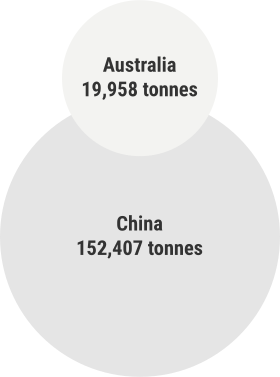
Australia could be one of the main beneficiaries of this dramatic increase in demand, where private companies and local governments alike are eager to expand the country’s nascent rare earths production. In 2021, Australia produced the fourth-most rare earths in the world. It’s total annual production of 19,958 tonnes remains significantly less than the mammoth 152,407 tonnes produced by China, but a dramatic improvement over the 1,995 tonnes produced domestically in 2011.
The dominance of China in the rare earths space has also encouraged other countries, notably the US, to look further afield for rare earth deposits to diversify their supply of the increasingly vital minerals. With the US eager to ringfence rare earth production within its allies as part of the Inflation Reduction Act, including potentially allowing the Department of Defense to invest in Australian rare earths, there could be an unexpected windfall for Australian rare earths producers.
